Back to roadmapBack to list

Schwungeinfahrt | Swing entry

This concept is also referred to as Schwungeinfahrt, or Zeilend binnenkomen.

Transport efficiencyTrains

Introduction

The concept of Swing entry (also known as Schwungeinfahrt or Zeilend binnenkomen) refers to allowing electric freight trains to enter terminals without active traction, using their residual speed. Instead of braking and switching to shunting locomotives, trains roll directly into position, reducing the need for additional movements and interventions. This approach enables more efficient and streamlined terminal operations.

Value proposition

  • Reduce time at the terminal

  • Increase capacity of rail transport

  • Simplify operations

  • Contribute to sustainability goals

Swing entry is used in ports to roll beneath terminal cranes, such that no locomotive is needed for this action. Swing Entry is expected to reduce time at the terminal with approximately one hour, and therefore increases the capacity of rail transport and lowers costs. It simplifies operations, because fewer locomotive and driver changes are needed. Moreover, it can support sustainability goals, as it no energy is needed on the terminals operations for the arrival of the trains.

Port applicability

Applicable to ports with railway access to terminals. Swing Entry requires electrification before and beyond the terminal so the train can leave the terminal again without a locomotive. Therefore, it cannot be used at terminals at the end of a train track.

Groups of innovations

  • There are no distinct groups identified.

Impact

Impact level per aspect
ImpactLevelRemark
Lower energy consumptionLimited impact
The train uses its existing momentum to roll into the terminal, avoiding additional traction and braking losses.
GHG emissionsLimited impact
Because no diesel locomotive is needed, it can help reduce CO2 emissions associated with terminal operations.
Operational efficiencyLarge impact
Reduction in shunting movements and time savings of approximately one hour per train.

Port characteristics

The concept requires electrification with enough power up to and beyond the terminal entry (but not in between), the possibility of the sufficient arrival speed (enough track length, no curves and no slope in the track), and clear signaling to support precise driver operation and safe traction cut-off. Back-up equipment has to be present in case of a stranded train.

Barriers and enablers

Barriers

  • KnowledgeBarrier

    Train drivers require specific skills and experience to execute Swing Entry.

  • InfrastructureBarrier

    It requires suitable infrastructure, such as electrification at the terminal, enough track space and the absence of a slope and curves in the tracks.

  • Stakeholder interactionBarrier

    The implementation of Swing Entry requires operational alignment between stakeholders. Operating requires precise planning, because trains need to drive at a specific speed to be able to execute Swing Entry.

How to implement?

  1. Step 1

    Feasibility assessment

  2. Step 2

    Infrastructure analysis and design

  3. Step 3

    Business case and stakeholder alignment

  4. Step 4

    Detailed engineering and planning

  5. Step 5

    Implementation and testing

  6. Step 6

    Operational rollout and training

Timeline

The arrow below represents the expected development of the TRL of swing entry.
* Technical Readiness Level

What should a port do in the next 3 years?

To begin the implementation of Swing Entry, the port has to assess whether it is feasible (enough track length, no curves and no slope in the track) and analyze if infrastructure needs to be adjusted.

Investment overview

Dependent on what is already in place at the terminal. CAPEX include electrification at the rail terminal, the overhead line before and beyond the terminal entry, signaling systems and back-up equipment. Moreover, train operators need to be reskilled to be able to execute Swing Entry. OPEX include the maintenance of electrification and signaling systems and the operations and maintenance of back-up equipment. Because the time at the terminal is reduced (higher turnover possible) and the procedure simplified (fewer locomotive and driver changes), the train operations may be more cost efficient in terms of OPEX.

Stakeholder overview

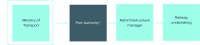
Below is an overview of the required involved stakeholders.
Blue stakeholders are essential, white stakeholders are enabling

Knowledge base