Port resilience against external manmade threats
Port resilience against external manmade threats concern a port’s ability to prepare, withstand, respond and recover from those external threats.
.jpg/82e2bf823d898073abd77b52c99dd30d/annereitsmafotografie.img_2152-2-edit-(1).jpg)
Introduction
Value proposition
Protects people
Both workers and society
Protects infrastructure and port operations
Reduce the likelihood and impact of an incident
Being resilient to external manmade threats protects people (both workers and society), infrastructure and port operations. Security measures, both physical and digital, can reduce the likelihood and impact of an incident. Crisis plans and backup systems help ports continue or restore essential activities. This also strengthens trust among port users and supply-chain partners.
Port applicability
Groups of innovations
Threat and vulnerability assessments
Identify external threats, critical assets, operational dependencies, and assign responsibilities to those risks. Timing: immediate; Pros: supports focused investments, and enables early detection of vulnerabilities, as well as strengthen overall preparedness and response readiness; Cons: requires regular updates.
Physical security and access control
Use barriers, surveillance and restricted areas to protect critical assets, and create alternative power, communication or access options. Timing: short term; Pros: reduces unauthorised access; Cons: may affect daily operations, and costs.
Threat detection and monitoring
Detect suspicious vessels, drones, vehicles or activities at an early stage. Timing: short to medium term; Pros: improves situational awareness; Cons: requires trained staff from port authorities, but also other organizations (army, police, etc.).
Crisis and continuity planning
Prepare response plans, backup procedures and clear responsibilities. Timing: immediate; Pros: limits disruption; Cons: requires regular exercises, and requires involvement of different relevant stakeholders which can be complex.
Information sharing and exercises
Exchange threat information and practise joint responses. Timing: immediate; Pros: improves coordination; Cons: sensitive information can be difficult to share and is sometimes scattered among stakeholders.
Impact
| Impact | Level | Remark |
|---|---|---|
| Safety and security | Very large impact | Reduces risks to staff, port users and nearby communities. |
| Resilience | Very large impact | Supports continuity and faster recovery after an incident. |
| Port-city and community | Large impact | Limits the consequences of incidents outside the port. |
| Port efficiency | Limited impact | Adds security procedures but helps prevent major disruption. |
Port characteristics
How to implement?
- Step 1
Identify threats, critical assets and dependencies
- Step 2
Prioritize the main risks and required measures
- Step 3
Define responsibilities and response procedures
- Step 4
Implement physical and organisational measures
- Step 5
Test plans with relevant stakeholders
- Step 6
Update measures using lessons from exercises
Timeline
.png/1a9bcebc9385fa64f6b70f81088182bc/port-resilience-against-external-manmade-threats-timeline-(1).png)
What should a port do in the next 3 years?
Investment overview
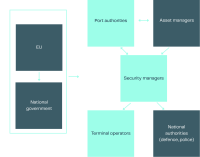
Stakeholder overview
Knowledge base
- https://etalpykla.vilniustech.lt/handle/123456789/160092: etalpykla.vilniustech.lt/handle/123456789/160092 (opens in new tab)
- Port resilience a systematic literature review: www.researchgate.net/publication/394079777_Port_resilience_a_systematic_literature_review (opens in new tab)
- Optimizing port system resilience through integrated preparedness and recovery strategies: www.sciencedirect.com/science/article/abs/pii/S0951832025009706 (opens in new tab)
- CER Directive: eur-lex.europa.eu/eli/dir/2022/2557/oj/eng (opens in new tab)
- ISPS-Code International code for the security of ships and of port facilities: puc.overheid.nl/nsi/doc/PUC_2396_14/2 (opens in new tab)
- Military mobility - European Commission: transport.ec.europa.eu/transport-themes/military-mobility_en (opens in new tab)