Nuclear Energy in Maritime Shipping
Port infrastructure for nuclear-powered vessels enables the safe berthing, servicing, fuel handling, waste management and emergency response of NPVs.

Introduction
Value proposition
Nuclear propulsion offers zero operational greenhouse gas (GHG) emissions
Nuclear propulsion offers extremely high energy density enabling unlimited vessel range
Fuel price stability
Ports that develop the necessary reception infrastructure position themselves as first-mover strategic nodes in an anticipated nuclear shipping supply chain, with significant commercial and reputational advantages
Nuclear propulsion offers zero operational greenhouse gas (GHG) emissions, extremely high energy density enabling unlimited vessel range, and fuel price stability, properties that directly address IMO 2050 net-zero targets for deep-sea shipping. Ports that develop the necessary reception infrastructure position themselves as first-mover strategic nodes in an anticipated nuclear shipping supply chain, with significant commercial and reputational advantages.
Port applicability
Groups of innovations
Nuclear-licensed berths
- Requires 5–10 years to design, license, and construct; new infrastructure category with no commercial precedent- early starters gain regulatory learning advantage. - Dedicated secured berthing with exclusion zones, perimeter controls, radiation monitoring, and physical security per IAEA recommendations. New construction or substantial adaptation of existing quayside. - TRL 2–4
Nuclear fuel exchange facilities
- Medium term; dependent on first commercial vessel timeline (est. late 2030s); refuelling cycles of several years mean bunker calls infrequent but high value. - Quayside or drydock shielded infrastructure for loading fresh nuclear fuel and removing spent fuel under controlled conditions. Requires specially trained personnel and licensing from the national nuclear authority (NNR). - TRL 3–5
SNF interim storage
- Technology mature for land-based applications; maritime scaling requires regulatory adaptation and national storage pathway to be in place before port operations can begin. - On-site or near-port interim storage for spent nuclear fuel pending transfer to licensed national deep geological repositories. Must comply with IAEA safeguards and NPT obligations. - TRL 4–6
Radioactive waste management
- Dependent on national waste infrastructure; cross-border transport agreements must be in place before commercial operation — currently a gap in most jurisdictions. - Handling, packaging, and transport logistics for radioactive operational waste from NPS vessels. Requires national waste management pathways and international transport agreements under IAEA conventions and INF Code. - TRL 4–6
Impact
| Impact | Level | Remark |
|---|---|---|
| GHG emissions (tank-to-wake) | Very large impact | Near-zero operational GHG from nuclear energy and propulsion; one of the most favorable energy sources on this metric. |
| GHG emission (well-to-wake) | Large impact | Very low lifecycle GHG; uranium enrichment and fuel supply chain introduce limited upstream emissions (~4–15 gCO₂eq/kWh for nuclear vs. 600–900 for gas). |
| Noise reduction | Medium impact | Nuclear propulsion produces no combustion noise during port calls, potentially reducing noise levels compared to conventional vessels. |
| Air pollution | Very large impact | Zero NOₓ, SOₓ, PM₂.₅ from nuclear operation; very large positive impact compared to diesel-based port energy and HFO ship propulsion. |
| Safety | Negative impact | Introduces new radiological hazard category absent from conventional ports; high-consequence risk requiring stringent, layered safety management (Gen IV designs improve inherent safety). |
| Thermal pollution | Negative impact | Nuclear-powered vessels release waste heat that must be managed through cooling. Local thermal impacts are expected to be limited but require careful design, monitoring and regulatory control. |
| Energy security and price stability | Medium impact | Ports receiving nuclear-powered vessels may benefit from reduced exposure to fossil fuel bunker market volatility, as nuclear-powered vessels do not require conventional bunkering. |
| Circularity and waste | Negative impact | Spent nuclear fuel and radioactive waste require long-term (centuries) management; open fuel cycle produces high-level waste; negative impact on circularity metrics. |
| Spatial impact | Negative impact | Small reactor footprint compared to equivalent energy capacity; however emergency planning zones (EPZs), security perimeters, and SNF storage require significant surrounding area: net limited positive spatial impact. |
| Human capital and workforce | Medium impact | Creates demand for high-skilled nuclear engineers, operators, and regulators; significant workforce development investment required — medium positive for local economy and expertise. |
Port characteristics
How to implement?
- Step 1
Policy & legal framework
Governments, IMO, IAEA
- Step 2
Port infra investment
Port authority, National government
- Step 3
First pilot vessels calls
Shipowners, Classification societies
- Step 4
Fefuelling & waste services
Port authority, Waste operators, NNR
- Step 5
Exploitation Commercial nuclear fleet servicing
Hub capability
Timeline
.png/c8633d005bfba52c14b6fcd322cbd084/nuclear-energy-in-marine-shipping-timeline-(1).png)
What should a port do in the next 3 years?
Investment overview
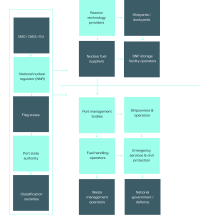
Stakeholder overview
Knowledge base
- DNV (2025).Maritime nuclear propulsion: Technologies, commercial viability, and regulatory challenges for nuclear-powered vessels.White Paper. Oslo: DNV.
- Lloyd's Register (2025).Navigating nuclear energy in maritime.London: LR.: www.lr.org/en/knowledge/research-reports/2025/navigating-nuclear-energy-in-maritime (opens in new tab)
- Furfari, S., & Mund, E. (2022). Advanced nuclear power for clean maritime propulsion.The European Physical Journal Plus,137(6), 747.
- ABB Marine & Ports (2025, March 26).Radical thinking needed on nuclear ship regulation.
- Wang, Q., Zhang, H., & Zhu, P. (2023). Using nuclear energy for maritime decarbonization: Regulatory shortcomings and improvements.Int. J. Environmental Research and Public Health,20(4), 2993.
- IMO (2023).2023 IMO GHG Strategy(Resolution MEPC.377(80)). London: IMO.: www.imo.org/en/ourwork/environment/pages/2023-imo-strategy-on-reduction-of-ghg-emissions-from-ships.aspx (opens in new tab)
- Roland Berger / Allseas (2025). Impact study.
- IAEA. Safety standards series — nuclear installations. Vienna: IAEA.: www.iaea.org/resources/safety-standards (opens in new tab)
- ESPO / EFIP.Good green practices — port use cases.Brussels: ESPO.: www.espo.be/publications/good-green-practices (opens in new tab)