Nuclear Energy for Port Operations
Nuclear power (MMRs, SMRs, FNPPs) provides zero-carbon electricity and heat for ports, shore power, and green fuel production.
.jpg/5dccc7c4a612f15af28121f0ff44bf71/nicolas-hippert-c82jaeqkfe0-unsplash-(1).jpg)
Introduction
Value proposition
Reliable energy source
Continuous energy source
Nuclear energy addresses the fundamental challenge of energy density and continuity that limits renewables as a standalone port energy solution. Various nuclear reactor technologies can provide reliable, high-capacity, base-load power with stable and predictable fuel costs over a multi-decade plant lifetime. SMRs, one such technology, remain relatively large in current designs, although ongoing development aims to reduce their size further. This could make them increasingly suited for port operations. It should be noted, however, that regulatory safety requirements do not necessarily scale down with reactor size, which may temper this anticipated advantage. This combination of reliability and continuity makes nuclear energy particularly suited to port operations, which often run 24/7 and require uninterrupted energy supply across cargo handling, refrigeration, and logistics. Beyond port operations itself, other modalities operating in and around the port, such as short-sea shipping and inland waterway transport, may also benefit from a stable nuclear energy supply, for example through shore power or green fuel production.
Port applicability
Groups of innovations
Land-based SMRs
- Mid-term feasible in nuclear-capable nations for larger SMR designs; high capital expenditure (CAPEX) but cost reduces significantly with mass production and type approval. Note: smaller, container-sized SMR concepts are still a long way from commercialisation. - Factory-built modular fission reactors (<300 MWe) with Gen III+/IV passive safety. Examples: NuScale VOYGR, Rolls-Royce SMR, GE-Hitachi BWRX-300. Scalable deployment possible in port-adjacent industrial zones. - TRL 4–7
Floating nuclear power plants (FNPPs)
- Demonstrated at commercial scale (Akademik Lomonosov, 2019); faster to site than land-based plants but mooring and marine safety requirements add complexity. - Barge- or ship-mounted reactors moored offshore or at quayside. Avoids land permitting constraints; Canadian FNPP project planned for 2030. Suitable for remote ports or islands. - TRL 6–8
Micro modular reactors (MMRs)
- Longer to commercialize than SMRs but potentially deployable at isolated port facilities; cost per kWe currently higher and estimates highly uncertain. MMRs are the smallest reactor category, including container-sized designs. - Very small reactors (<20 MWe), heat-pipe or gas-cooled (e.g. Westinghouse eVinci, HOLOS-Quad, nano reactor). Compact and air-cooled designs remove need for large cooling water systems. - TRL 3–5
Nuclear-to-hydrogen / ammonia coupling
- Long-term (post-2035); dependent on HTGR/Gen IV commercial availability, but potentially transformative for port-scale green fuel bunkering hubs. - High-temperature process heat from Generation IV reactors (HTGR) driving thermochemical or high-temperature electrolysis for co-production of green hydrogen and ammonia at port scale. No MAGPIE product; concept stage. - TRL 3–5
Impact
| Impact | Level | Remark |
|---|---|---|
| GHG (Tank-to-wake | Very large impact | Near-zero operational GHG from nuclear energy and propulsion |
| GHG (well-to-wake) | Large impact | Very low lifecycle GHG; uranium enrichment and fuel supply chain introduce limited upstream emissions (~4–15 gCO₂eq/kWh for nuclear vs. 600–900 for gas). |
| Noise reduction | Medium impact | Nuclear power generation produces no combustion noise at port; eliminates diesel generator noise from port energy supply. |
| Air pollution | Very large impact | Zero NOₓ, SOₓ, PM₂.₅ from nuclear operation; very large positive impact compared to diesel-based port energy. |
| Safety | Negative impact | Introduces new radiological hazard category absent from conventional ports; high-consequence risk requiring stringent, layered safety management (Gen IV designs improve inherent safety) |
| Thermal pollution | Negative impact | Reactor cooling systems can discharge heated water to port water bodies; must be assessed in environmental impact study per Lloyd's Register (2025) guidance |
| Energy security/ price stability | Very large impact | Firm baseload independent of weather; nuclear fuel price stable and predictable over multi-decade lifetime; reduces port exposure to fossil fuel price volatility. |
| Circularity | Negative impact | Nuclear fuel and radioactive waste require long-term (centuries) management; open fuel cycle produces high-level waste; negative impact on circularity metrics. |
| Spatial impact | Limited impact | Small reactor footprint compared to equivalent energy capacity; however EPZs, security perimeters, and SNF storage require significant surrounding area: net limited positive spatial impact. |
| Human capital and workforce | Medium impact | Creates demand for high-skilled nuclear engineers, operators, and regulators; significant workforce development investment required — medium positive for local economy and expertise. |
Port characteristics
How to implement (from a port's perspective)?
- Step 1
Feasibility and regulatory mapping
Port authorization & National government
- Step 2
Site selection and licensing
Port autorization, NNR, Industry
- Step 3
Construction
Reactor vendors & EPC
- Step 4
Operations & grid integration
Port Authorization & Energy supplier
- Step 5
Exploitation: scale-up & H2 coupling
Full ecosystem
Timeline
.png/f1ce719ddbf33dae9090e0f6e9a02b93/nuclear-energy-for-port-operations-timeline-(1).png)
What should a port do in the next 3 years?
Investment overview
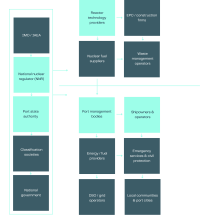
Stakeholder overview
Knowledge base/ References
- IMO (2023).2023 IMO GHG Strategy(Resolution MEPC.377(80)). London: IMO.: www.imo.org/en/ourwork/environment/pages/2023-imo-strategy-on-reduction-of-ghg-emissions-from-ships.aspx (opens in new tab)
- Pacific Northwest National Library and NRIC. (2026). Small Nuclear Reactors for Maritime Ports – A Feasibility Study.: nric.inl.gov/content/uploads/34/2026/07/Small_Nuclear_Reactors_for_Maritime_Ports_PNNL-39328.pdf (opens in new tab)
- IAEA. Safety standards series — nuclear installations. Vienna: IAEA.: www.iaea.org/resources/safety-standards (opens in new tab)
- IAEA. Deployment of Floating Nuclear Power Plants: Benefits and Challenges. Summary of an International Symposium, Vienna, November 2023.: www-pub.iaea.org/MTCD/publications/PDF/PUB2145web.pdf (opens in new tab)
- ESPO / EFIP.Good green practices — port use cases. Brussels: ESPO.: www.espo.be/publications/good-green-practices (opens in new tab)
- World Nuclear Association. Small modular reactors.: world-nuclear.org/information-library/nuclear-power-reactors/small-modular-reactors/small-modular-reactors (opens in new tab)
- Shore power: /factsheets/shore-power (opens in new tab)