Back to roadmapBack to list

Automated dismantling and recycling

Ship dismantling and recycling is the final stage of a ships lifetime and relates to CRM, critical raw materials.

CircularInland shippingMarine shipping

Introduction

Ship dismantling and recycling is the final stage of a ships lifetime and creates a final income for the ship owner. The lower the costs of this activity, the more money ship owners get back for their vessel. As dismantling is labour intensive and taking care of waste is expensive as well, it is often associated with the beaches landings, where this is often done with disregard for peoples’ safety and the environment. However, clean and automated ship dismantling and recycling could be a source of large volumes of high quality materials at more or less competing prices. So a benefit of doing it properly could be created in the EU.

Value proposition

  • Reduce labor intensity

  • Allow for recycling

  • Contribute to supply of critical resources

Ship recycling is a very labour intensive industry and as a result has moved to countries where the cost of labour is lower, often coupled with less stringent norms on the environment and on safety. Automated dismantling and recycling would reduce the labour intensity of the work and allow recycling of ships to take place in countries where cost of labour is significantly higher. This would also contribute to the supply of (critical) resources, ensuring access to high quality materials in a port and, if done in Europe, this region. This addresses both the EU CRM goals and the EU CEAP. If, as a result, a strong secondhand materials market is created, also partially or none-automated recycling may be feasible against competitive pricing.

Port applicability

Ports that plan on offering (automated) ship recycling options should have access to sufficient space, sufficient demand (suitable ships) nearby and sufficient depth at the site for these ships. A benefit of the EU is that most ships arrive full and leave empty, so recycling in the EU minimizes the final travelling distance. For automated dismantling, larger ships are more beneficial, so being close to a port that many such ships frequent is key. However, currently only smaller ships including inland barges are recycled in the EU, as a result of the price differences. Any ports and companies considering recycling, should at least, for the start, consider this.

Groups of innovations

  • Cutting processes

    Automated dismantling is a broad term that primarily focuses on the cutting processes. Cutting can be done by robots or chains, while transport between cutting stations (there is a primary cutting station to cut the vessel into blocks and secondary and tertiary cutting to make these block smaller and into plates and bars) can be done with personnel or also automated.

Impact

Impact level per aspect
ImpactLevelRemark
Energy useLimited impact
Energy is used for cutting.
Noise reductionLimited impact
The noise will be similar to regular recycling, comparable to a shipyard.
Resource useLarge impact
More resource, like steel and rare metals will become available to offset raw material usage.

Port characteristics

Most automated dismantling companies are still in a concept phase, though an increasing number of parties is active in the field today. All are looking for suitable (access to large ships, sufficient depth, access to downstream markets, sufficient space and suitable to adhere to environmental legislations) locations and ports meeting the requirements could use these activities as a suitable replacement for other types of industry that are withdrawing.

Barriers and enablers

Enablers

  • Standards & regulationsEnabler

    EU legislation is not allowing beaching and polluting forms of recycling and it is promoting reuse and circularity and as such, stimulates the development of viable secondhand market or remanufacturing market. This would create a demand for the (automated) recycling yards.

Barriers

  • InfrastructureBarrier

    The most critical barrier is downstream infrastructure. Recycling can only function if there is demand for its output. Preferably not the raw materials but re-using the actual equipment and sub-constructions, as this maintains the value and increases the income of this activity. Currently, such a circular economy is missing (due to a chicken and egg problem), which would require a large market to be created.

  • EconomicsBarrier

    To offset the labour costs, large investments in robots are required, so the upfront risk is higher, making it a less attractive investment. Yet when successful it could provide work for many skilled labourers.

  • TechnologyBarrier

    Most of the technology are recent developments and are not extensively field tested, this could be a benefit in keeping it local/exclusive, but more likely poses additional risks.

How to implement?

  1. Step 1

    Find developers

  2. Step 2

    Recycling yards

  3. Step 3

    Circular cluster

Timeline

The arrow below represents the expected development of the TRL of automated dismantling and recycling. At the moment, several companies are working on robotization and other innovative automated cutting solutions. These are ready, close to ready to be implemented in full scale pilots (TRL 7). Implementing this activity as a single pilot is difficult, due to high investment costs, so most are looking to set up a recycling location for a longer time and improve their equipment over several operational cycles. Besides this, we see regular recycling companies trying to offer repurposing services, but the market is still too small to operate efficiently.
* Technical Readiness Level

What should a port do in the next 3 years?

Once pilots are conducted successfully by companies in the port, ports could support the further development of a downstream market. Ports are key in offering such a location, but could also be supportive further by attracting/promoting downstream industries to settle near the recycling yard, creating a valuable (circular) cluster of companies.

Investment overview

CAPEX consists of the investments in (innovative) robots, the preparation of the location (leak proof, safe, etc). OPEX consists primarily of the energy used and, if only partially automated, of the labour force required.

Stakeholder overview

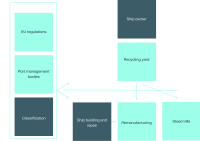
Below is an overview of the required involved stakeholders. As discussed above, key is a resale markets, first for recycling/remelting of steel, but preferable at higher value levels for remanufacturing, bringing it back within the shipping industry. The EU is actively promoting circularity and is looking for ways to maintain CRMs, so they offer clear incentives. Finally, as the activities take place inside the ports, they should adhere to port regulations (and be supported by it/part of the ports’ vision).
Blue stakeholders are essential, white stakeholders are enabling

Knowledge base