Back to roadmapBack to list

Hydrogen supply

Hydrogen or H2 is expected to play a key role in the transition towards sustainable and climate-neutral ports as an energy carrier.
Alternative fuelsMarine shippingPort/terminal

Introduction

Hydrogen or H2 is expected to play a key role in the transition towards sustainable and climate-neutral ports as an energy carrier. As demand for clean energy grows across transport, industry, and logistics, ports are becoming important hubs for hydrogen production, import, storage, and distribution. To support the decarbonisation of port operations, industry, and parts of the maritime sector, an efficient hydrogen supply chain is required.

Value proposition

  • Decarbonize hard-to-abate sectors

  • Feedstock for various industries

Hydrogen can help decarbonise sectors that are difficult to electrify, including high-grade heat industry and shipping. It can replace fossil fuels as an energy source, feedstock, or marine fuel. Next to that, is H2 a feedstock for various industries, like refining and chemical industry, creating several demandmarkets (an diversification possibilities). H2 is colour-labelled according to its production method, being for a net zero emissions future, the more relevant, gGreen hydrogen is produced is produced using renewable electricity with and has very no direct low emissions, while and blue hydrogen, is produced from natural gas with carbon capture, resulting in lower but not zero emissions.

Port applicability

A hydrogen supply chain requires production or import facilities, storage, transport, distribution infrastructure, and sufficient end-user demand. Hydrogen can be transported as a gas, liquid, or through carriers such as ammonia, and methanol, or a LOHCs (Liquid Organic Hydrogen Carriers). Ports that already handle chemicals, gases, or liquid bulk cargo can benefit from existing infrastructure, safety regulations/precautions and expertise. The development of hydrogen supply chains is strongly driven by demand and requires a clear business case.

Groups of innovations

  • Gaseous hydrogen

    Often suitable for regional distribution and local industrial use.

  • Liquid hydrogen (LH2)

    Cooled to extremely low temperatures (-253 degrees), enabling higher energy density.

  • Ammonia (NH₃)

    A hydrogen carrier that is easier to store and transport than pure hydrogen. It can be used directly as a fuel or converted back into hydrogen.

    Ammonia demand
  • Methanol

    A liquid hydrogen carrier and fuel that can leverage existing fuel infrastructure and logistics chains. It is not commonly converted back into hydrogen.

    Methanol demand
  • Liquid Organic Hydrogen Carriers (LOHCs)

    Organic liquids that absorb and release hydrogen, allowing transport using conventional liquid bulk infrastructure. Various types of LOHC’s exist.

Impact

Impact level per aspect
ImpactLevelRemark
GHG emissionsLarge impact
Level Ddependings on the source of hydrogen, helps enable decarbonisation of hard-to-abate of difficult to electrolyze sectors
SafetyMedium impact
Requires safety measures, regulations, and risk management (magnitude is subject to carrier, e.g. LOHC has safer handling than LH2).
Port energy systemMedium impact
Increases electricity demand (for where H2 is produced locally via electrolysis) and requires integration with renewable energy and energy storage systems.
Operations and logisticsMedium impact
Potentially introduces new cargo flows and handling procedures
EconomicsLarge impact
Requires substantial investment; can be reduced by retrofitting existing infrastructure, depending on the carriers already handled in the port.

Port characteristics

A hydrogen supply chain requires production or import facilities, storage, transport, distribution infrastructure, and sufficient end-user demand. Hydrogen can be transported as a gas, liquid, or through carriers such as ammonia, and methanol, or a LOHCs (Liquid Organic Hydrogen Carriers). Ports that already handle chemicals, gases, or liquid bulk cargo can benefit from existing infrastructure, safety regulations/precautions and expertise. The development of hydrogen supply chains is strongly driven by demand and requires a clear business case. Sufficient space for production, storage, handling, and transport infrastructure is required. Access to suitable infrastructure and technologies, such as terminals, storage facilities, pipelines, and bunkering systems, is essential. A viable business case can be driven by local demand or by a port's role as a transit hub.

Barriers and enablers

Enablers

  • EconomicEnabler

    Strong and predictable demand from industry, transport, or maritime users is a key enabler for hydrogen supply chain development, while uncertainty about future demand can delay investments and slow market growth.

    MAGPIE Price Incentives non-tech solution
  • Stakeholder interactionEnabler

    The development of a hydrogen supply chain requires close collaboration between ports, energy producers, infrastructure operators, industry, transport providers, and governments.

  • TechnologyEnabler

    The commercial availability and proven performance of many hydrogen technologies reduce technological uncertainty and support the early deployment of hydrogen supply chain infrastructure.

  • Standards & regulationsEnabler

    Supportive regulations, funding schemes, and decarbonisation policies can accelerate hydrogen adoption, improve competitiveness, and help overcome the "chicken-and-egg" challenge in which infrastructure and demand depend on each other's development.

Barriers

  • EconomicsBarrier

    High upfront investment requirements for hydrogen production, storage, transport, and distribution infrastructure can be a significant barrier, particularly when new infrastructure is needed and future demand and revenue streams remain uncertain.

  • EconomicsBarrier

    Green hydrogen remains significantly more expensive to produce than fossil-based ("grey") hydrogen and, in most regions, than blue hydrogen. High costs are driven primarily by renewable electricity prices, electrolyser CAPEX, and low utilisation rates. Until energy costs fall and a clear price premium for clean hydrogen is established, uptake is likely to remain limited to subsidised projects and hard-to-abate applications as the fossil alternatives are much cheaper.

How to implement?

  1. Step 1

    Asess hydrogen demand and stakeholders

  2. Step 2

    Develop shared roadmap

  3. Step 3

    Create enabling conditions

  4. Step 4

    Develop infrastructure and end-use applications

Timeline

The arrow below represents the expected development of the TRL of hydrogen supply.
* Technical Readiness Level

What should a port do in the next 3 years?

The first step for ports is to understand where hydrogen demand is expected to emerge. This helps determine the scale and timing of future hydrogen needs and identifies the key stakeholders that should be involved in developing the supply chain. After that, the port should scan which activities are already in place and which need to be developed.

Investment overview

CAPEX: Developing a hydrogen supply chain can require significant capital investments in production facilities (e.g. electrolyzsers), import terminals, storage tanks, pipelines, distribution infrastructure, bunkering facilities, and safety systems. Ports which do have (some) facilities are expected to be frontrunners, due to costsavings. OPEX: Operational costs are driven by energy consumption, hydrogen production or procurement costs, infrastructure maintenance, storage and transport activities, as well as personnel and safety management.

Stakeholder overview

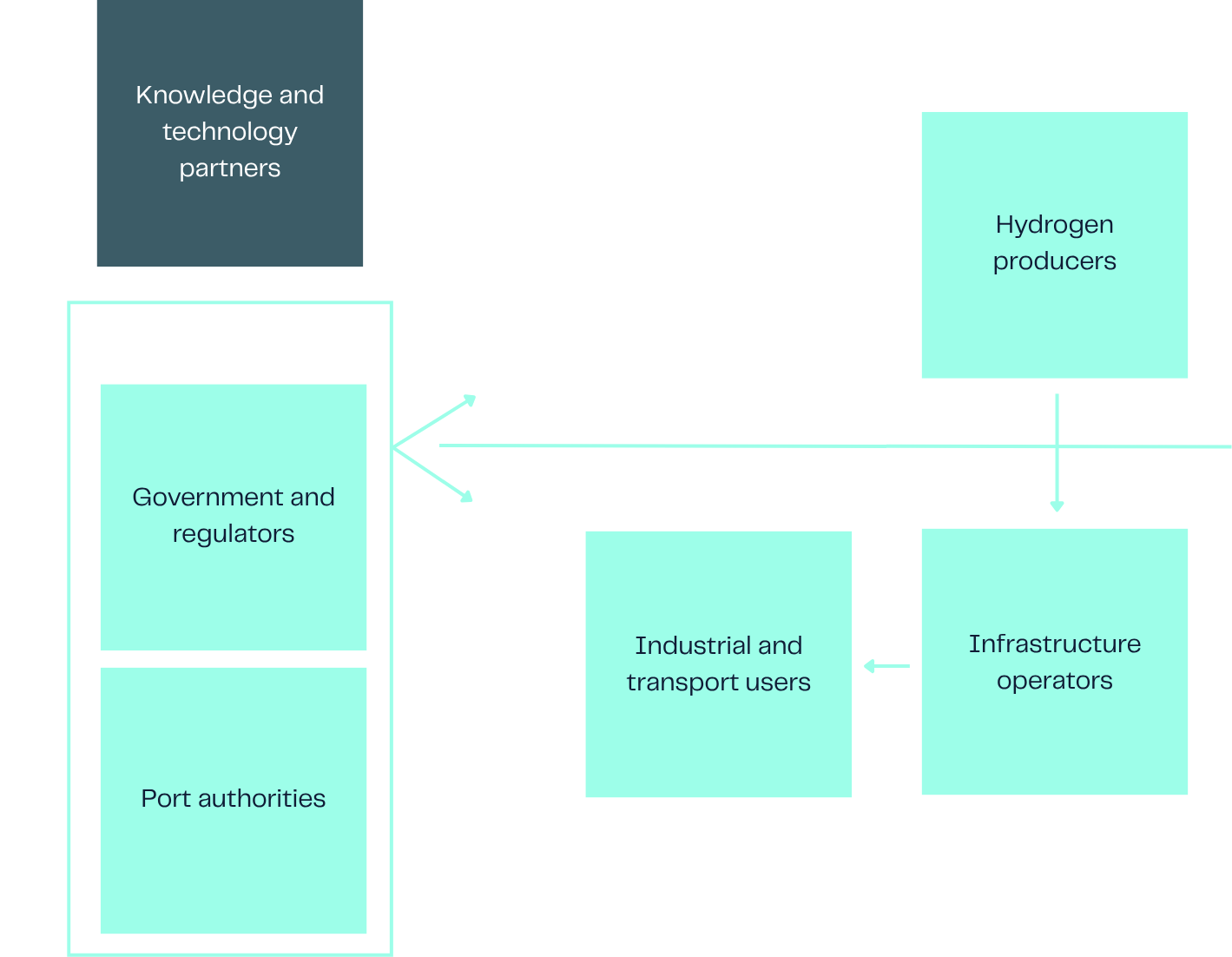
The development of a hydrogen supply chain requires collaboration between a wide range of stakeholders. Port authorities play an important role in coordinating stakeholders, facilitating planning processes, and supporting the development of infrastructure. Hydrogen producers supply hydrogen (carriers). Industrial companies, transport operators, and/or maritime users create demand, helping to establish a viable business case for the supply chain. Governments and regulators support development through regulations, permitting frameworks, funding mechanisms, and incentives, while knowledge institutions and technology providers contribute through innovation, expertise, and workforce development. Below is an overview of the required involved stakeholders.
Mint stakeholders are essential, grey stakeholders are enabling

Knowledge base